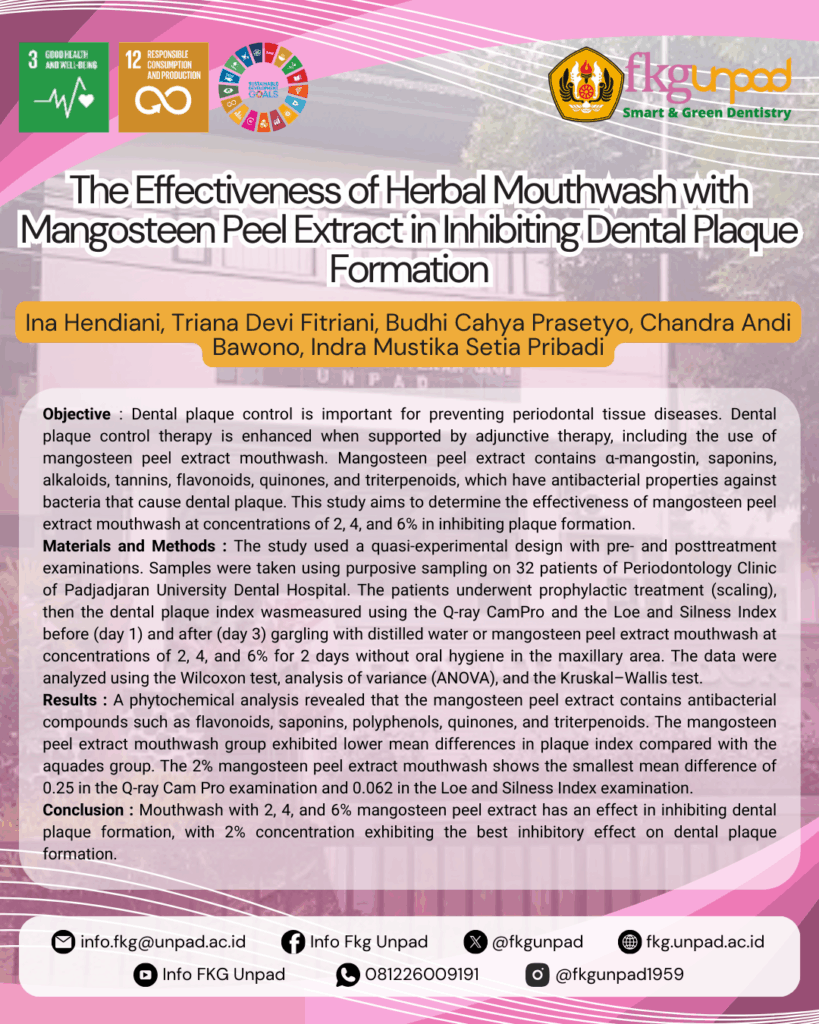
The Effectiveness of Herbal Mouthwash with Mangosteen Peel Extract in Inhibiting Dental Plaque Formation

This study tested mangosteen peel extract mouthwash (2%, 4%, 6%) for dental plaque control in 32 patients. All concentrations reduced plaque, with the 2% mouthwash showing the most effective inhibition. Mangosteen’s antibacterial compounds support its use as an adjunctive therapy for preventing plaque formation. Read full paper : https://doi.org/10.1055/s-0044-1791502 #FKGUnpad#SDGs#BetterOralHealth#GlobalSustainability#SustainableDevelopmentGoals#SmartGreenDentistry#SustainableDentistry#SDG3#SDG12

The Effectiveness of Herbal Mouthwash with Mangosteen Peel Extract in Inhibiting Dental Plaque Formation Read More »

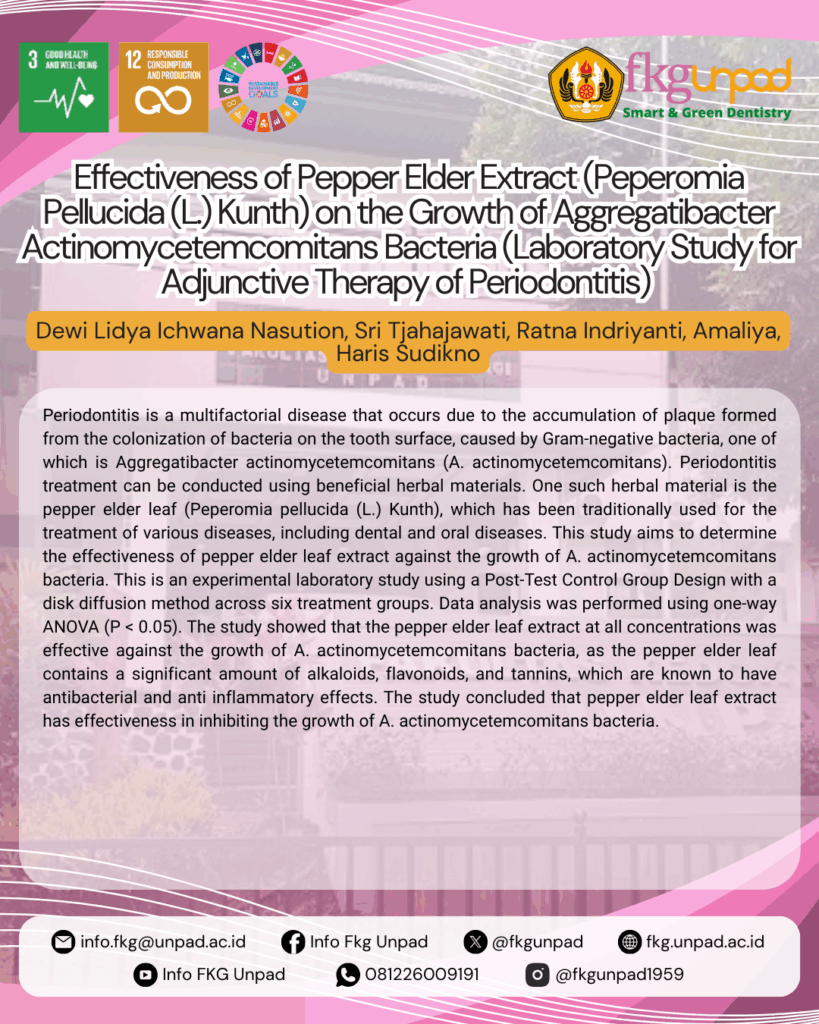
Effectiveness Of Pepper Elder Extract (Peperomia Pellucida (L.) Kunth) On The Growth Of Aggregatibacter Actinomycetemcomitans Bacteria (Laboratory Study For Adjunctive Therapy Of Periodontitis)

This study tested the antibacterial effect of pepper elder leaf (Peperomia pellucida) extract against Aggregatibacter actinomycetemcomitans, a key bacterium in periodontitis. Using a laboratory disk diffusion method, all concentrations of the extract showed inhibitory effects. The antibacterial activity is linked to its alkaloids, flavonoids, and tannins. The study concludes that pepper elder leaf extract is

Effectiveness Of Pepper Elder Extract (Peperomia Pellucida (L.) Kunth) On The Growth Of Aggregatibacter Actinomycetemcomitans Bacteria (Laboratory Study For Adjunctive Therapy Of Periodontitis) Read More »

In Vitro Anticancer Potential of Eugenol on Oral Cancer Cell Lines: A Systematic Review

This systematic review examined the anticancer effects of eugenol on oral squamous cell carcinoma (OSCC) using in vitro studies. Thirteen high-quality articles showed that eugenol can induce cell death, inhibit cell proliferation, and affect oxidative stress in oral cancer cell lines. The findings suggest that eugenol has strong potential as an anticancer agent for OSCC.

In Vitro Anticancer Potential of Eugenol on Oral Cancer Cell Lines: A Systematic Review Read More »

Description of Saliva Cortisol Levels in Indonesian Navy Soldiers before and After Using Virtual Reality Dental Hypnosis Tool

This study tested the effect of virtual reality dental hypnosis (VRDH) on dental anxiety in Indonesian military members by measuring salivary cortisol levels. In a randomized controlled trial with 22 participants, most showed decreased cortisol after intervention, with greater changes seen in the VRDH group compared to controls. The results suggest VRDH may help reduce

Description of Saliva Cortisol Levels in Indonesian Navy Soldiers before and After Using Virtual Reality Dental Hypnosis Tool Read More »

The Use Of Antimicrobial Photodynamic Therapy In Chronic Periodontitis Treatment: Rapid Review

This rapid review analyzed 9 studies on antimicrobial photodynamic therapy (aPDT) as an adjunct to scaling and root planing in chronic periodontitis. Results showed that aPDT improved clinical parameters, with reductions in probing depth, better clinical attachment levels, and less bleeding on probing compared to scaling and root planing alone. Read full paper : http://www.jidmr.com/journal/wp-content/uploads/2024/12/67-Rev-D24_3266_Agus_Susanto_Indonesia.pdf

The Use Of Antimicrobial Photodynamic Therapy In Chronic Periodontitis Treatment: Rapid Review Read More »

Virtual Reality for Pain Controlling in the Adult During Dental Treatment: a Systematic Review

This systematic review analyzed 15 studies on the use of virtual reality (VR) for pain control in adult dental patients. Results showed that VR is effective in reducing acute pain during procedures like anesthesia, extraction, scaling, and root planing. The review supports integrating VR into dental practice as a tool to ease both physical and

Virtual Reality for Pain Controlling in the Adult During Dental Treatment: a Systematic Review Read More »

Microstructural Evaluation of Dental Implant Success Using Micro-CT: A Comprehensive Review

This review highlights the role of micro-computed tomography (micro-CT) in evaluating bone microstructure for dental implant success. Micro-CT provides detailed 3D visualization to assess bone volume, trabecular structure, and osseointegration, though it faces challenges in artifacts and in vivo use. Advances in resolution and AI integration may improve its clinical applications, with future research needed

Microstructural Evaluation of Dental Implant Success Using Micro-CT: A Comprehensive Review Read More »

Influence of bite force and implant elastic modulus on mandibular reconstruction with particulate-cancellous bone marrow grafts healing: An in silico investigation

This study used a finite element model of a canine mandible to simulate healing of particulate cancellous bone marrow (PCBM) grafts with porous implants under different bite forces and implant materials. Results showed faster healing with lower bite forces and stiffer implants, with bone growth starting from outer regions and moving inward. Titanium alloy (Ti6Al4V)

Influence of bite force and implant elastic modulus on mandibular reconstruction with particulate-cancellous bone marrow grafts healing: An in silico investigation Read More »

Enhancing pediatric endodontic treatment: Intraosseous anesthesia with computer-controlled delivery system

This case report highlights the use of computer-controlled local anesthetic delivery (CCLAD) for intraosseous anesthesia in an 8-year-old undergoing vital pulpectomy. The technique provided effective pain control with minimal discomfort and reduced risk of bone damage. CCLAD proved to enhance pediatric endodontic treatment by ensuring comfort and safety. Read full paper : https://doi.org/10.20473/j.djmkg.v57.i3.p228-233 #FKGUnpad#SDGs#BetterOralHealth#GlobalSustainability#SustainableDevelopmentGoals#SmartGreenDentistry#SustainableDentistry#SDG3#SDG9

Enhancing pediatric endodontic treatment: Intraosseous anesthesia with computer-controlled delivery system Read More »

Evaluation of foot analysis in the presence of dental malocclusion: A systematic review

This review examined the relationship between foot posture/function and dental malocclusion. From 248 studies, only 5 met the criteria, showing some links between postural imbalance and occlusal changes during the mixed dentition phase. However, evidence remains limited, and more precise longitudinal studies are needed using comprehensive parameters, including mandibular position, tongue function, habits, and temporomandibular

Evaluation of foot analysis in the presence of dental malocclusion: A systematic review Read More »

Scroll to Top